The Physics of Communication: How Monster N-Lite Clear Talk Masters the Noisy World
Update on Jan. 3, 2026, 6:14 p.m.
In the evolution of personal audio, we have largely solved the problem of input—how to deliver high-fidelity music to your ears. We have massive drivers, lossless codecs, and active noise cancellation. But the problem of output—how to deliver your voice clearly to others—remains a stubborn frontier.
Wind noise, traffic rumble, and the chatter of open offices conspire to destroy intelligibility. The “Can you hear me now?” frustration is a failure of physics.
The Monster MH22107 N-Lite Clear Talk Wireless Earbuds are engineered specifically to conquer this problem. While they carry the “Monster” legacy of big sound, their true innovation lies in their microphone architecture. By integrating CVC 8.0 Noise Reduction and a 4-Microphone ENC Array, they function less like traditional headphones and more like a focused acoustic lens.
This article deconstructs the science of clear communication. We will explore the mathematics of CVC algorithms, the geometry of beamforming, and why these earbuds represent a shift from passive listening to active transmission.
Stratum I: The Algorithm of Clarity (CVC 8.0)
“CVC” stands for Clear Voice Capture. It is a suite of algorithms developed by Qualcomm, designed to run on the Bluetooth chipset inside the earbud.
Unlike Active Noise Cancellation (ANC), which cancels noise for you (the listener), CVC cancels noise for the person you are talking to.
The Spectral Subtraction Technique
The core of CVC 8.0 is Spectral Subtraction.
1. Sampling: The microphones capture a mix of your voice (the signal) and the background environment (the noise).
2. Analysis: The DSP (Digital Signal Processor) analyzes the frequency spectrum. Human speech has a specific harmonic structure (fundamental frequency + overtones). Noise, like wind or traffic, tends to be broadband or repetitive.
3. Subtraction: The algorithm identifies the “noise profile” and mathematically subtracts it from the total signal.
The challenge is to do this without making the voice sound robotic or “underwater.” CVC 8.0 uses advanced Packet Loss Concealment and Bit Error Correction to ensure that even if some data is lost in the processing or transmission, the voice remains natural and fluid. This computational heavy lifting happens in microseconds, ensuring zero perceived latency in conversation.
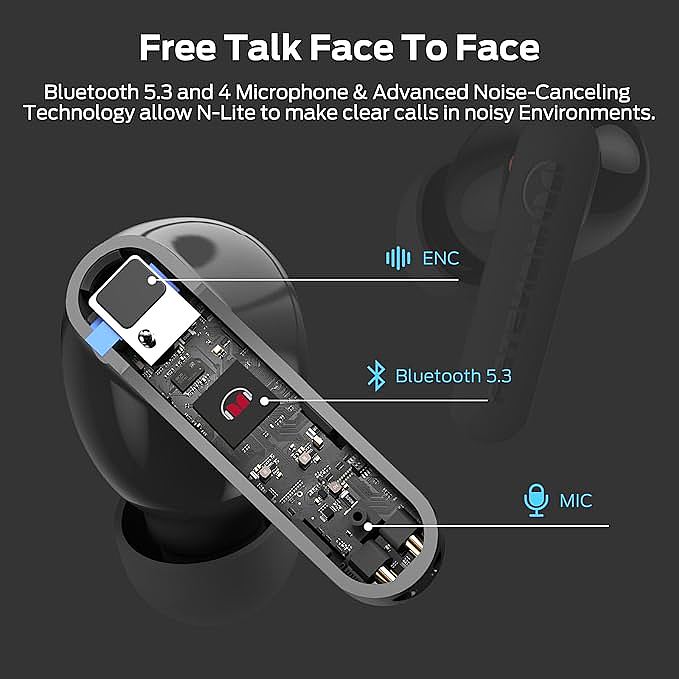
Stratum II: The Geometry of Beamforming (4-Mic ENC)
Algorithms need good data. To separate your voice from the noise effectively, the N-Lite Clear Talk uses Environmental Noise Cancellation (ENC) powered by a 4-Microphone Array.
The Spatial Filter
Having two microphones on each earbud allows for Beamforming. * Mic A (Primary): Located at the bottom of the stem, pointed towards your mouth. It captures your voice + noise. * Mic B (Secondary): Located on the outer shell, facing away from your mouth. It captures mostly noise.
The DSP compares the arrival time of sound waves at Mic A vs. Mic B. * Sound that hits Mic A first (your voice) is prioritized. * Sound that hits Mic B first or hits both simultaneously (ambient noise) is identified as “off-axis” and suppressed.
This creates a virtual “cone of silence” around your mouth. Only sound originating from this specific spatial vector is allowed to pass through the filter. This geometric approach is why the N-Lite Clear Talk can isolate your voice even in a crowded café or on a windy street.
Stratum III: The Foundation of Sound (10mm Drivers)
While communication is the focus, the “Monster” heritage demands performance in music. The MH22107 utilizes 10mm Drivers.
In the world of earbuds, 10mm is a “Goldilocks” size. It is significantly larger than the 6mm drivers found in budget buds, but smaller than the 13mm+ drivers in “bass-head” models.
The Physics of Balance
- Bass Response: The 10mm diaphragm moves enough air to provide a solid, punchy low end (the “Pure Monster Sound” signature). It utilizes Bass+ Technology, which likely involves a specialized EQ curve and a high-excursion suspension to boost lower frequencies by up to 35% without distortion.
- Vocal Clarity: Crucially, a 10mm driver retains the transient response needed for clear mids. This is vital for calls. If the bass is too overwhelming (masking effect), you won’t hear the other person clearly. The 10mm size strikes a balance, ensuring that both the beat of the music and the articulation of speech are preserved.

Stratum IV: The Power of Persistence (60 Hours Playtime)
Communication tools must be reliable. A dead battery during a conference call is unacceptable.
The N-Lite Clear Talk boasts a staggering 60 Hours of total playtime (with the case). This is achieved through high-density Lithium-Polymer chemistry and the efficiency of Bluetooth 5.3.
Fast Charging Dynamics
The inclusion of USB-C Fast Charging is a critical workflow feature.
“10 minutes charge = 2 hours play.”
This is made possible by the battery management system (BMS) allowing a high current influx (C-rate) during the initial charging phase (Constant Current stage) before tapering off. For the professional on the go, this means a quick top-up during a coffee break guarantees enough power for the next meeting.
Conclusion: The Professional’s Audio Tool
The Monster N-Lite Clear Talk transcends the category of “music accessory.” It is a productivity tool.
By mastering the physics of beamforming and the algorithms of spectral subtraction, it ensures that your voice—your most powerful instrument of influence—is transmitted without compromise.
It acknowledges that in the modern world, we work from anywhere. And to work from anywhere, you need audio gear that can silence the chaos of “anywhere.”


