The Productivity Anchor: Why Professionals Are Returning to Neckbands
Update on Jan. 3, 2026, 6:23 p.m.
In the lexicon of modern work, “friction” is the enemy. Every second spent pairing a device, searching for a lost earbud, or waiting for a charge is a second lost from deep work or critical communication. While True Wireless Stereo (TWS) earbuds have captured the consumer imagination with their sci-fi aesthetics, they have introduced a new set of frictions into the professional workflow. Enter the wireless neckband: a device that, arguably, represents the most “frictionless” audio form factor for the power user.
The Philips PN505 Wireless Neckband Headphones illustrate this thesis perfectly. They are not designed to be invisible; they are designed to be reliable. For the remote worker, the field engineer, or the frequent flyer, the neckband offers a suite of operational advantages—from battery endurance to tactile notifications—that transform it from a mere accessory into an essential productivity tool.
The Anxiety of Power: Solving the Battery Bottleneck
The fundamental flaw of the TWS form factor is volumetric. Batteries do not follow Moore’s Law; their capacity is strictly defined by their physical size. A tiny earbud can only hold a tiny charge, typically capping out at 4-6 hours of continuous use before needing to return to a case. For a professional on back-to-back Zoom calls or a long-haul flight, this interruption is unacceptable.
The neckband architecture changes the math. By housing the battery in the collar rather than the ear, devices like the PN505 can achieve up to 14 hours of play time (or 10 hours with Active Noise Canceling engaged). This crosses a critical threshold: the “workday horizon.” A device that lasts 14 hours does not need to be nursed. It does not require “top-ups” during lunch. It effectively removes battery anxiety from the user’s cognitive load, allowing them to focus entirely on the task at hand.
Furthermore, the integration of Rapid Charging technology addresses the edge cases. The ability to garner 2 hours of play time from just 5 minutes of charging is a lifesaver for the disorganized professional. It turns the brief window between meetings into a complete refuel, ensuring that the tool is ready whenever the user is.
The Physics of Communication: Echo Cancellation and Stability
In a professional setting, audio quality is bidirectional. It is not enough to hear; one must be heard. TWS earbuds notoriously struggle with microphone performance because the microphones are located at the ear, far from the mouth, requiring aggressive (and often destructive) digital processing to isolate the voice.
The neckband form factor offers a geometric advantage. The control modules on the neckband cables sit closer to the jawline and mouth. This physical proximity improves the signal-to-noise ratio before digital processing even begins. The PN505 further enhances this with built-in echo cancellation.
Echo cancellation is vital for conference calls. Without it, the microphone can pick up the sound of the remote speaker coming from the earbuds, creating a feedback loop that destroys communication intelligibility. By using advanced algorithms to identify and subtract the speaker output from the microphone input, the PN505 ensures a “clear, undisturbed connection.” This reliability builds trust in professional interactions—you know you aren’t the person on the call causing the audio glitch.
The Tactile Interface: Vibration and Blind Control
Touch controls on TWS earbuds are often finicky—prone to accidental touches or unresponsive to sweaty fingers. They require the user to memorize complex tap sequences (one tap for play, two for skip, three for assistant).
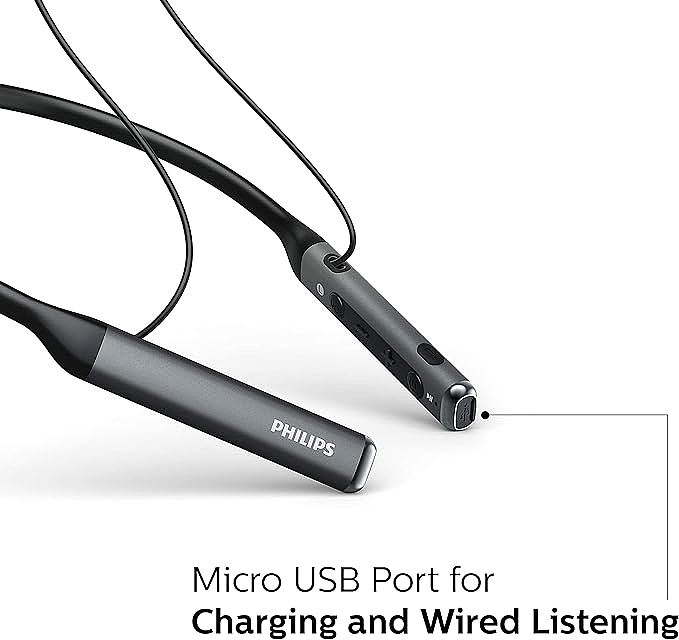
The neckband restores the dignity of the physical button. The PN505 features tactile controls on the neckband that can be operated by feel alone. Muscle memory develops quickly, allowing users to mute a mic, adjust volume, or answer a call without ever breaking eye contact with their screen or their conversation partner.
Moreover, the vibrating neckband is a subtle yet powerful notification system. In an open office or a quiet home, loud ringtones are intrusive. A vibration on the collar is personal and impossible to miss. It allows the user to leave the earbuds out—resting comfortably on the chest—while remaining connected to the digital notification stream. This “standby mode” is unique to neckbands. It offers the connectivity of a smartwatch with the immediate audio readiness of headphones.
The Security of “Wearability”
Finally, we must address the “loss anxiety” inherent in TWS products. An earbud that falls out is an earbud that is lost, stepped on, or dropped down a subway grate. This necessitates a constant, low-level vigilance that drains mental energy.
The neckband is a tethered system. If an earbud slips out, it falls three inches and hangs safely. When not in use, the device doesn’t need to be boxed away; it simply becomes a necklace. This slender and lightweight neckband design integrates into the user’s wardrobe. It is always there, physically secure. For the active professional—the site inspector climbing a ladder, the commuter running for a train—this security is paramount. It transforms the headphone from a delicate electronic jewel into a rugged, dependable piece of gear.
Conclusion: The Professional’s Choice
While consumer trends drift towards the invisible, the professional world values the tangible. The Philips PN505 succeeds not because it follows the TWS trend, but because it refines the proven strengths of the neckband. By combining marathon battery life, superior microphone physics, tactile controls, and physical security, it offers a productivity value proposition that “true wireless” cannot match. In the workflow of the modern professional, reliability is the ultimate luxury, and the neckband is the architecture of reliability.


