No Hookup, No Problem: The Science Behind How Countertop Dishwashers Work
Update on Nov. 10, 2025, 5:49 a.m.
In the grand narrative of domestic innovation, the quest to conquer the kitchen sink has been a century-long endeavor. This daily battle against soiled dishes famously spurred Josephine Cochrane in 1886 to invent the first mechanical dishwasher, sparking a revolution aimed at liberating people from manual labor. Today, that revolution is adapting to a new reality: the compact footprint of modern life. In apartments, dorms, and RVs, where space is a premium and plumbing modifications are often impossible, a new class of appliance has emerged.
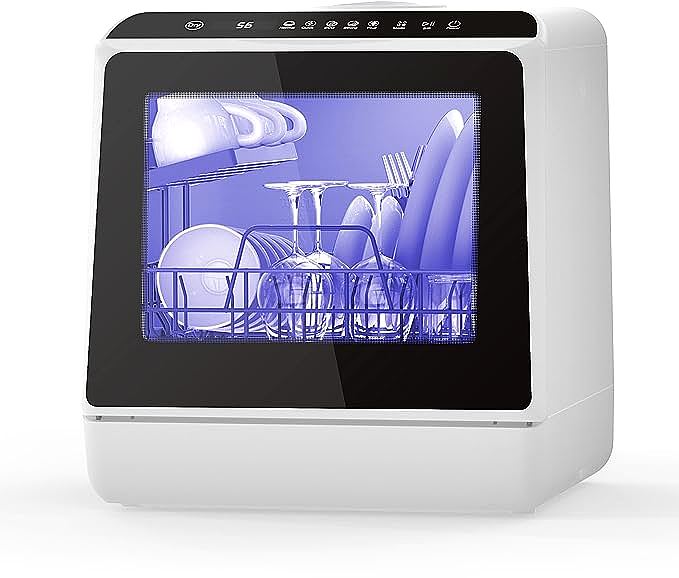
The countertop dishwasher, exemplified by popular models like the HAVA TDQR01, is not merely a downsized machine. It represents a fundamental re-engineering of the cleaning process, concentrating powerful scientific principles into a compact form. This article delves into the thoughtful science that allows these small wonders to deliver not just convenience, but a level of hygienic clean that is often superior to washing by hand.

The Engineering of Freedom: Deconstructing the Dual Water Supply
The most liberating feature of a countertop dishwasher is its ability to operate without a permanent plumbing connection. This is the core innovation that makes it viable for renters and mobile lifestyles. The HAVA dishwasher, for instance, achieves this through a versatile dual water supply system.
1. Faucet Mode: For those with a compatible faucet, the machine can be connected via an included inlet hose. A diverter attaches to the tap, allowing you to switch between normal faucet use and supplying the dishwasher. This is a simple, semi-permanent setup.
2. Water Tank Mode: This is the true game-changer. The HAVA features a built-in 5-liter (1.3-gallon) water tank. The process is ingeniously simple: * You manually fill the tank through an opening at the top of the unit. * The machine’s internal pump draws the precise amount of water needed for the selected wash cycle. * A separate drain hose simply rests in the sink to expel the wastewater.
This self-contained system completely untethers the appliance from your plumbing, requiring only a power outlet and a place to drain. It’s this engineering that allows it to function in a dorm room, an office, or an RV with equal ease.

The Science of a Superior Clean in a Compact Form
Achieving a deep, hygienic clean in a small chamber is a feat of applied science, combining fluid dynamics and thermodynamics.
Fluid Dynamics: 360° Cleaning Power: The HAVA dishwasher employs dual spray arms, one at the top and one at the bottom, equipped with a total of 14 water ports. These arms rotate, creating a 360-degree vortex of high-pressure water jets. This isn’t a gentle rinse; the machine converts a small volume of water into a powerful mechanical scrubbing force. This systematic, multi-angle spray ensures that water reaches every surface, from the base of a cup to the tines of a fork, providing a level of consistent, forceful cleaning that is difficult to replicate by hand.
Thermodynamics: The Power of Heat for Sanitization and Drying: The machine’s ability to heat water is crucial. The Heavy/Baby Care cycle is engineered to reach high temperatures, which serves two purposes. First, hot water is exceptionally effective at dissolving grease and oils. Second, and more importantly, it sanitizes. Temperatures exceeding 150°F (65.5°C) can significantly reduce common household bacteria, providing a level of hygiene that handwashing in lukewarm water simply cannot match.
This thermal process extends to the Extra Dry mode. After the final rinse, the machine circulates heated air for an additional 60 minutes. This accelerates evaporation, leaving dishes not only dry and spot-free but also providing a final hygienic step. The 72-hour ventilated storage function then periodically circulates air to prevent any residual moisture from creating stale odors.

Efficiency by Design: Saving Water, Energy, and Sanity
In an age of environmental consciousness, the efficiency of our appliances is a key metric of their value.
Water Conservation: The HAVA dishwasher uses a mere 5 liters (1.3 gallons) of water per cycle. This is a dramatic reduction compared to handwashing, which can easily consume up to four times that amount or more. This efficiency is achieved by intelligently filtering and recirculating the wash water, maximizing its cleaning potential before the final rinse.
Energy Efficiency: With an “A” grade energy efficiency rating and a 900W power draw, the appliance is designed to perform its tasks without putting undue strain on your electricity bill. The 5 distinct wash programs—from a quick “Speed” cycle to an energy-saving “ECO” mode—allow you to tailor consumption to the specific cleaning task at hand.
Acoustic Engineering: Designed for close quarters, the unit operates at a quiet 50 dB. This is comparable to the hum of a modern refrigerator and is a result of careful insulation and motor design, ensuring that your home remains a peaceful environment even while the dishes are being done.

The countertop dishwasher is more than a convenience; it’s a testament to how focused engineering can solve real-world problems. By concentrating the core scientific principles of cleaning into a compact, efficient, and versatile package, appliances like the HAVA TDQR01 bring the benefits of automated, hygienic dishwashing to a whole new audience. It represents a significant step forward in the ongoing quest to make modern living simpler, cleaner, and more sustainable, no matter the size of the kitchen.