The Ergonomic Verdict: Power, Voltage, and the "Headband" Factor
Update on Dec. 13, 2025, 7:01 p.m.
Comfort is geometry. Power is chemistry. The Baixhur BH-OEH-02 attempts to balance both in a $30 package. While it succeeds in many areas, forensic analysis reveals specific physical limitations that users must navigate—specifically regarding how it fits your head and how you feed its battery.
The 17-Hour Marathon: Single-Charge Dynamics
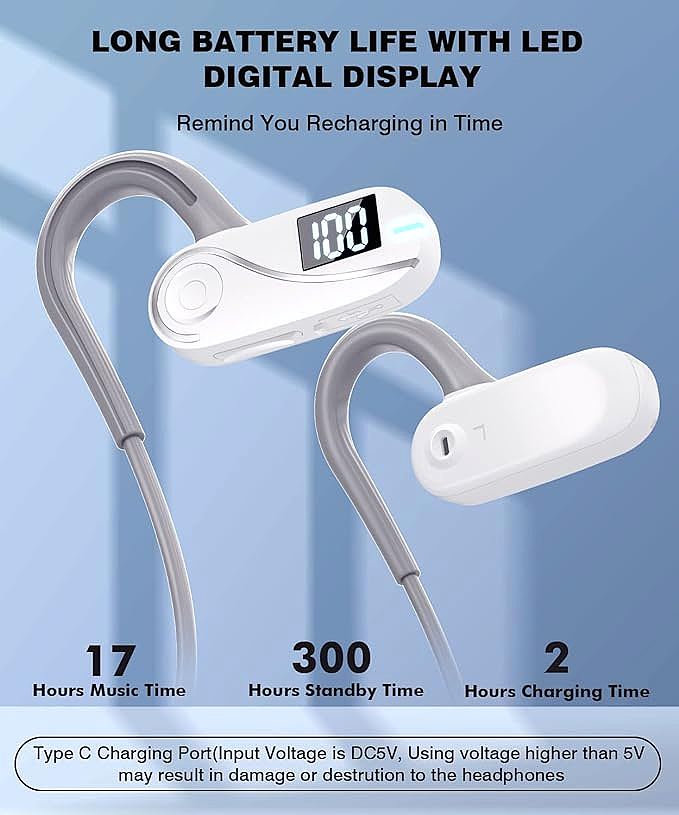
Unlike True Wireless Stereo (TWS) earbuds that rely on a charging case to boost their numbers, the Baixhur is a single unit with a large internal battery. The claim of 17 hours of music time is significant (Data). * The Reality: This is 17 continuous hours. A TWS earbud might die after 5 hours and need a 20-minute break in the case. The Baixhur keeps going. For endurance athletes or delivery drivers, this continuity is invaluable. * The Interface: The integrated LED Digital Battery Display is a rare and highly functional feature in this class. Instead of guessing if “Red Light” means 10% or 40%, you get a precise percentage (Visual Proof). This allows for precise “range anxiety” management.
FMEA: The Silent Killer (High Voltage)
A critical warning is buried in the product description: “Input voltage is DC5V. Using voltage higher than 5V may result in damage.”
In 2025, most of us use USB-C Power Delivery (PD) chargers for our phones and laptops. These smart chargers should negotiate the voltage down, but budget headphones often lack the compliant handshake chips.
Field Note: Do NOT plug these headphones into your 65W laptop charger or a 20W+ phone fast charger. The handshake may fail, sending 9V or more into a 5V circuit, frying the power management IC instantly.
The Fix: Use an old-school 5V/1A “slow” charger (like the old iPhone blocks) or plug it into a PC USB port. This simple discipline is the difference between a device that lasts 2 years and one that dies in 2 weeks.
The Geometry of Fit: The Wraparound Dilemma
The Baixhur uses a flexible “memory wire” headband that wraps around the back of the neck. * The Pro: It creates a clamping force that keeps the drivers positioned over the ear without plugging the canal. It is virtually impossible to lose one earbud. * The Con: It competes for real estate behind your ear. As user “Valerie montano” noted, wearing glasses makes them “a little bulkier.” * The Analysis: If you wear thick-framed glasses, the ear hook of the headphone and the temple of your glasses will fight for the same space. This can cause the glasses to tilt or the headphones to push out, reducing volume consistency.
TCO Analysis: The Hygiene Dividend
While the fit has geometric limits, the Open Ear design pays a health dividend. By not plugging the ear canal, you eliminate the warm, moist environment where bacteria thrive (often caused by TWS buds). This reduces the risk of otitis externa (swimmer’s ear), potentially saving you a trip to the doctor. The “Total Cost of Ownership” includes your medical copays—or lack thereof.
Conclusion: A Tool, Not a Toy
The Baixhur BH-OEH-02 is a utilitarian tool. It trades the sleekness of tiny earbuds for the battery endurance of a neckband. It trades the isolation of ANC for the safety of air conduction. And it demands a bit of respect at the charging outlet. If you can accept these engineering trade-offs, it is a formidable companion for the long haul.


