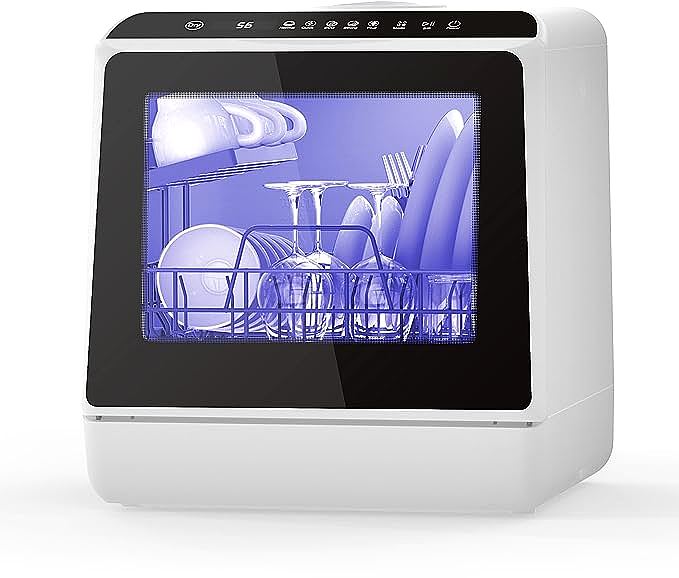
The Engineering of Compact Cleaning: A Countertop Dishwasher Deep Dive
Update on Nov. 10, 2025, 7:15 a.m.
In the modern landscape of compact apartments, RVs, and small homes, every square inch of counter space is valuable. This spatial constraint has often forced a frustrating compromise: the convenience of an automatic dishwasher versus the necessity of handwashing.
However, a class of “compact” appliances has risen to this challenge. The countertop dishwasher is not merely a “shrunken” version of a full-size machine; it is a dedicated piece of engineering that must solve a unique problem: how to achieve a full-power, hygienic clean within a constrained volume.
The answer lies in a precise balancing act between spatial optimization, fluid dynamics, and thermodynamics. Let’s deconstruct the science packed inside these compact cleaning allies.

1. The Physics of Space: Spatial Optimization
The first engineering hurdle is the box itself. A typical countertop dishwasher measures only around 17 inches high, 22 inches wide, and 20 inches deep. The challenge is to translate this small footprint into a useful capacity.
This is solved through ergonomic spatial design. The internal racking is a three-dimensional puzzle, engineered to hold a 6-place-setting capacity. This industry standard (often up to 70 pieces of tableware) is achieved with tines and baskets precisely angled to accommodate dinner plates (up to 10 inches), bowls, and cups without “nesting”—a state where items shield each other from water. Models like the Comfee WQP6-3602H-W are examples of this optimization, fitting a small family’s daily load into a space barely larger than a microwave.
2. The Power of Force: Fluid Dynamics
A common misconception is that “smaller” means “weaker.” In reality, compact dishwashers must be smarter with their water pressure. They compensate for limited space with aggressive fluid dynamics.
A full-size machine’s single spinning arm is insufficient in a cramped tub. Instead, high-performance compact units employ a “total coverage” system. * Multiple Nozzles: The “Heavy” cycle on a unit like the Comfee WQP6-3602H-W utilizes 12 individual washing nozzles rather than just a few slots on an arm. * Complex Spray Patterns: These nozzles are engineered to create a 360° spiral spray wash. This is a hydro-dynamic vortex, ensuring that high-pressure water jets are blasted from multiple angles, reaching every surface and corner.
This system of force ensures that a 10-inch plate caked with food receives the same cleaning power as it would in a full-size machine, just through more focused and intense application of water pressure.
3. The Power of Heat: Thermodynamics & Sanitization
This is the most critical scientific advantage a dishwasher has over handwashing: heat.
Our hands cannot safely tolerate water above 120°F (49°C). But to truly break down stubborn, baked-on grease (a process called saponification) and to sanitize, higher temperatures are required.
This is where the “Heavy” or “Baby-Care” cycles become essential. These programs engage a powerful internal heating element to raise the water temperature to specific, programmed thresholds. Many high-performance countertop units are engineered to reach 68°C (approximately 154.4°F).
This temperature is a key scientific benchmark:
1. Chemical Efficacy: It dramatically accelerates the chemical reactions of the detergent, “melting” grease and oils.
2. Sanitization: 154.4°F is well above the temperature needed to kill most common household bacteria and pathogens (like E.coli and Salmonella).
This thermal takedown ensures a level of hygiene that handwashing simply cannot achieve. User reviews for these units often confirm the presence of this heating element, noting that running the hot water tap first (a pro-tip for any dishwasher) helps the machine reach its peak temperature more efficiently and extends the life of the element.
4. The Power of Efficiency: Balancing Act
This combination of high-pressure spray and high-temperature heat must be balanced against modern energy demands. This is where Energy Star certification becomes critical.
An Energy Star certified compact dishwasher, like the Comfee WQP6-3602H-W, is a model of efficiency. * Energy: It may consume as little as 174 kWh per year. * Water: It is remarkably frugal. The “Speed” cycle (a 45-minute option for light loads) can use as little as 2.77 gallons of water. This is a fraction of the 20+ gallons often consumed when handwashing an equivalent load. * Noise: Acoustic engineering, including insulation and motor dampening, keeps the noise level at a quiet 49 dB—about the level of a library or a modern refrigerator.
5. The Final Hurdle: Installation
Unlike some portable models, this class of countertop dishwasher is not a “fill-it-yourself” tank. It requires a water inlet and a drain, just like its full-size counterpart.
However, it’s engineered for flexibility. It does not require a plumber to permanently cut into your pipes. The system is designed to be “faucet-connectable.” With a simple, widely available adapter (sold at hardware stores), the inlet hose screws directly onto your kitchen faucet, and the drain hose simply rests in the sink.
This “plumbed-but-portable” design provides the power of a permanent connection with the flexibility required for apartments, dorms, and rental homes.
Conclusion: A Specialized Tool, Not a Toy
The 6-place-setting countertop dishwasher is a prime example of targeted engineering. It is not a compromised, “weaker” version of a full-size appliance. It is a specialized solution that uses the advanced principles of fluid dynamics (360° spiral spray) and thermodynamics (68°C sanitization) to deliver a powerful, hygienic, and efficient clean in a compact, flexible package.